
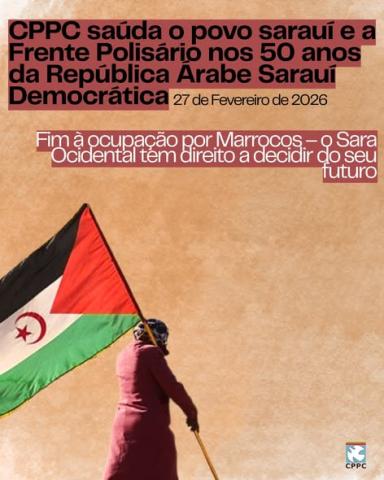
CPPC salutes the Sahrawi people and the Polisario Front on the 50th anniversary of the Sahrawi Arab Democratic Republic End of occupation by Morocco – Western Sahara has the right to decide its future
Peoples have the right to self-determination, to decide their collective destinies, to chart the paths of development they deem most appropriate, to sovereignly dispose of the resources of their territories for their own benefit. This is a principle enshrined in international law, which the Constitution of the Portuguese Republic embraces in its Article 7.
As we mark the 50th anniversary of the proclamation of the Sahrawi Arab Democratic Republic, the Portuguese Council for Peace and Cooperation (CPPC) warmly greets the Sahrawi people and the Polisario Front, their legitimate representative, and reaffirms that this right to self-determination must also apply to the Sahrawi people, who for more than half a century have resisted the violent occupation of part of the territory of Western Sahara and the theft of its valuable natural resources by the Kingdom of Morocco.
Western Sahara is defined in international law as a “non-self-governing” and “yet to be decolonized” territory, with a separate and distinct legal status from Morocco, which no one – regardless of their military strength and the power of their allies – can question.
Since 1975, Morocco has illegally occupied territories of Western Sahara, exercising violent repression against the Sahrawi population, attacking territories under the control of the Polisario Front, and illegally exploiting the natural resources of Western Sahara for the benefit of Moroccan and other countries' companies. As a consequence of this illegal occupation – carried out and maintained by force of arms – thousands of Sahrawi people were forced to seek refuge in Algeria, where they live to this day.
The UN pointed to a referendum, organized under the auspices of the United Nations, as a way for the Sahrawi people to exercise their right to self-determination. The referendum was never held due to Morocco's permanent boycott, supported by the US, Israel, and several powers of the European Union, and the occupation continues to be imposed against the will and rights of the Sahrawi people.
The "autonomy plan" presented by Morocco does not guarantee the realization of the just and legitimate right to self-determination of the Sahrawi people, as it is merely a hidden way of maintaining the Moroccan occupation, the theft of natural resources in the occupied territory, and the oppression of the Sahrawi population. However, successive Portuguese governments have supported this plan, even considering it the only "realistic, serious and credible proposal," in clear disregard for the inalienable right to self-determination of the Sahrawi people. While advocating for negotiation as a solution to this conflict, one cannot confuse negotiations with impositions, nor negotiate what is non-negotiable: the right of the Sahrawi people to sovereignly decide their future.
The Portuguese Government is required to recognize the Sahrawi Arab Democratic Republic and adopt an interventionist position, consistent with the right of colonized peoples to self-determination and independence, namely the Sahrawi people, in accordance with Article 7 of the Constitution of the Portuguese Republic, which advocates the abolition of imperialism, colonialism and any other forms of aggression, domination and exploitation in relations between peoples. Therefore, the Portuguese Government must, within the framework of its international relations, firmly and clearly defend the fulfillment of the rights of peoples and international law, actively advocating for respect for the national rights of the Sahrawi people.
What should be discussed and negotiated is not the way to maintain the Moroccan occupation and the undue appropriation of the Sahrawi people's resources – which holds both the Kingdom of Morocco and countries and entities, such as the European Union, responsible for negotiating the exploitation of these same resources – but rather the fulfillment of the Sahrawi people's right to self-determination.
The CPPC is continuing its action of solidarity with the national cause of the Sahrawi people and with the Polisario Front, and will demand the guarantee of the rights of the Sahrawi population in the illegally occupied territories, the release of Sahrawi political prisoners detained in Moroccan prisons, and the end of the occupation of Western Sahara.
On the day before issuing this communiqué, the CPPC and other 29 portuguese organizations sent a solidarity message with the Sahrawi people saluting the 50th anniversary of the Sahrawi Arab Democratic Republic.
February 27, 2026
The National Directorate of the CPPC
--/
CPPC saúda o povo sarauí e a Frente Polisário nos 50 anos da República Árabe Sarauí Democrática
Fim à ocupação por Marrocos – o Sara Ocidental tem direito a decidir do seu futuro
Os povos têm o direito à autodeterminação, a decidirem dos seus destinos coletivos, a traçarem os caminhos de desenvolvimento que entendam mais convenientes, a disporem soberanamente dos recursos dos seus territórios em seu próprio benefício. Este é um princípio consagrado no direito internacional, que a Constituição da República Portuguesa acolhe no seu artigo 7.º.
No momento em que se assinala o 50.º aniversário da proclamação da República Árabe Sarauí Democrática o Conselho Português para a Paz e Cooperação (CPPC) saúda calorosamente o povo sarauí e a Frente Polisário, sua legítima representante, e reafirma que esse direito à autodeterminação também tem de se aplicar ao povo sarauí, que há mais de meio século resiste à violenta ocupação de parte do território do Sara Ocidental e ao roubo dos seus valiosos recursos naturais por parte do Reino de Marrocos.
O Sara Ocidental é definido no direito internacional como um território “não autónomo” e “ainda por descolonizar”, com estatuto jurídico separado e distinto de Marrocos, que ninguém – independentemente da sua força militar e do poderio dos seus aliados – pode pôr em causa.
Desde 1975 que Marrocos ocupa ilegalmente territórios do Sara Ocidental, exercendo uma violenta repressão sobre a população sarauí, atacando territórios sob o controlo da Frente Polisário e explorando ilegalmente os recursos naturais do Sara Ocidental em proveito de empresas marroquinas e de outros países. Como consequência desta ilegal ocupação – realizada e mantida pela força das armas –, milhares de sarauís foram obrigados a procurar refúgio na Argélia, onde vivem até aos dias de hoje.
A ONU apontou como forma de exercício do direito à autodeterminação do povo sarauí a realização de um referendo, organizado sob os auspícios das Nações Unidas. O referendo nunca foi realizado, devido ao permanente boicote de Marrocos, sustentado pelos EUA, por Israel e por várias potências da União Europeia, continuando a ser imposta a ocupação contra a vontade e os direitos do povo sarauí.
O “plano de autonomia”, apresentado por Marrocos, não garante a concretização do justo e legítimo direito à autodeterminação do povo sarauí, pois constitui apenas uma forma encapotada de manter a ocupação marroquina, o roubo dos recursos naturais no território ocupado e a opressão da população sarauí.
No entanto, sucessivos governos portugueses têm dado apoio a este plano, considerando-o inclusive como a única «proposta realista, séria e credível», num claro desrespeito do inalienável direito à autodeterminação do povo sarauí. Defendendo a via negocial para a solução deste conflito, não se pode confundir negociações com imposições, nem negociar o que é inegociável: o direito do povo sarauí a decidir soberanamente do seu futuro.
Do Governo português exige-se o reconhecimento da República Árabe Sarauí Democrática e a adoção de uma posição interventiva, coerente com o direito dos povos colonizados à autodeterminação e independência, nomeadamente do povo sarauí, no respeito do artigo 7.º da Constituição da República Portuguesa que preconiza a abolição do imperialismo, do colonialismo e de quaisquer outras formas de agressão, domínio e exploração nas relações entre os povos. Pelo que, o Governo português deve, no quadro das suas relações internacionais, defender de forma firme e clara o cumprimento dos direitos dos povos e do direito internacional, pugnando de forma activa pelo respeito dos direitos nacionais do povo sarauí.
O que se deve discutir e negociar não é a forma de manter a ocupação marroquina e a apropriação indevida dos recursos do povo sarauí – que responsabiliza tanto o Reino de Marrocos como países e entidades, como a União Europeia, que com este negoceiam a exploração desses mesmos recursos – e sim o cumprimento do direito à autodeterminação do povo sarauí.
O CPPC prosseguirá a sua ação de solidariedade com a causa nacional do povo sarauí e com a Frente Polisário e de exigência da garantia dos direitos da população sarauí nos territórios ilegalmente ocupados, da libertação dos presos políticos sarauís detidos em prisões marroquinas, do fim da ocupação do Sara Ocidental.
27 Fevereiro 2026
A Direção Nacional do CPPC